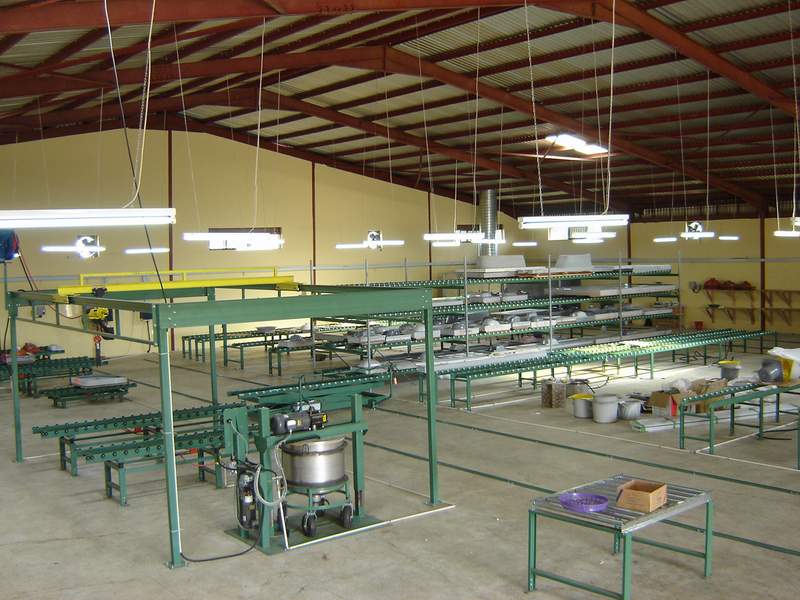
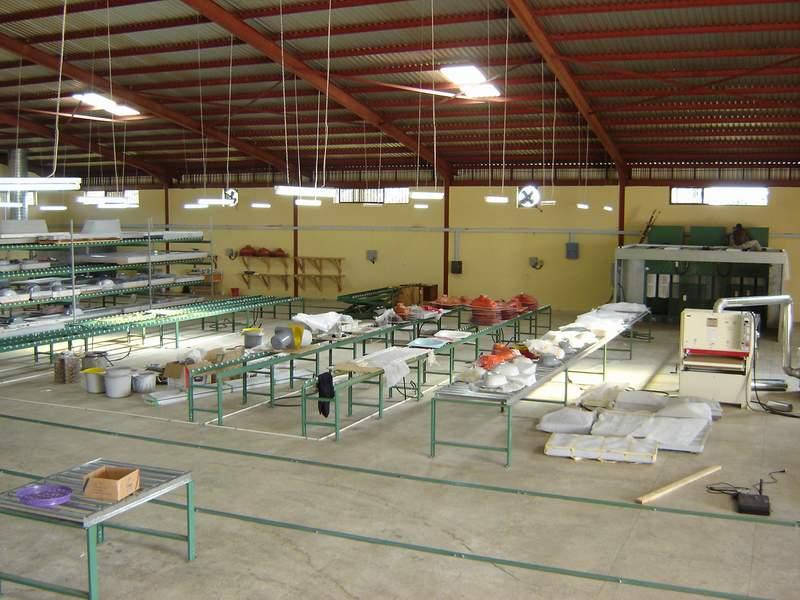
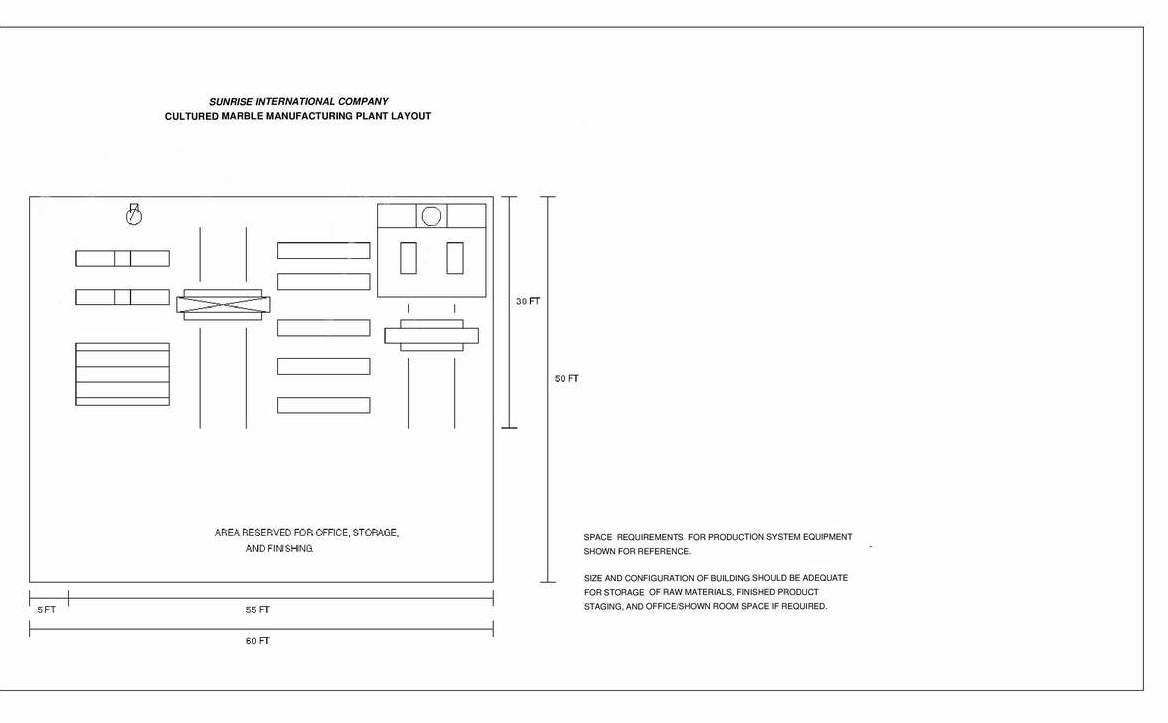
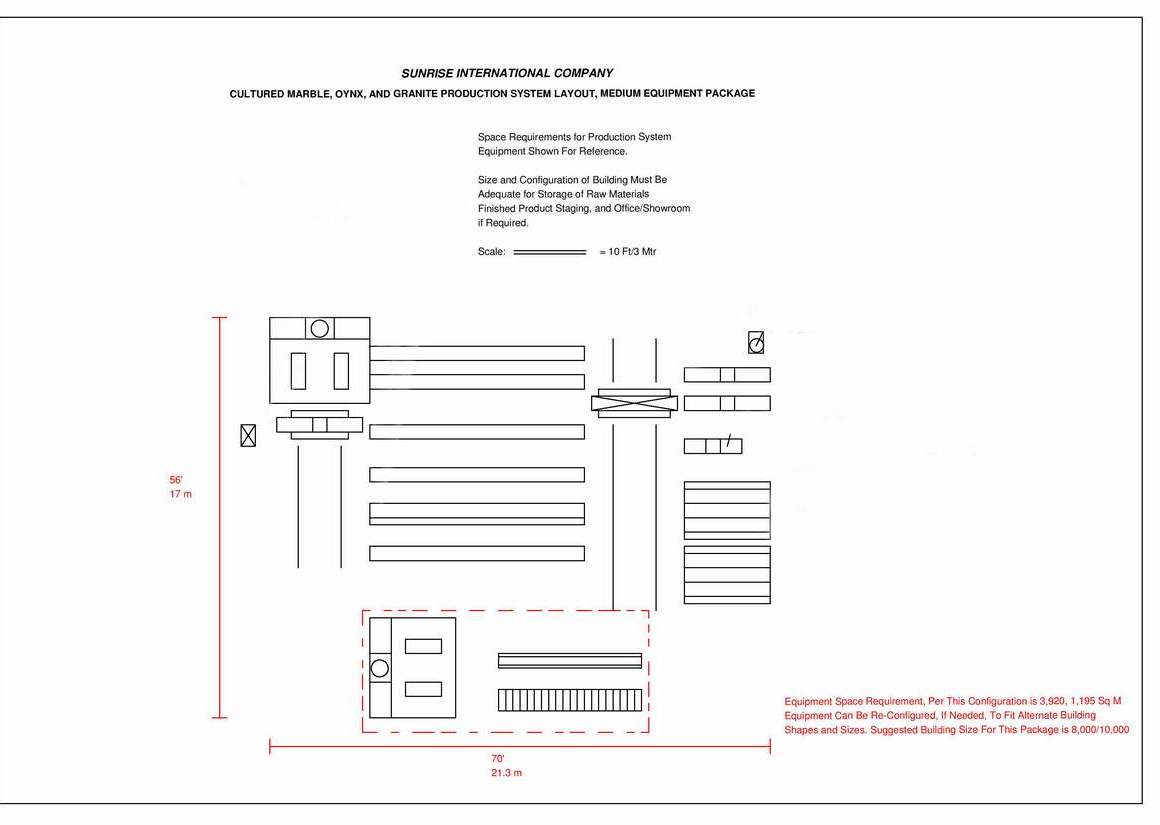
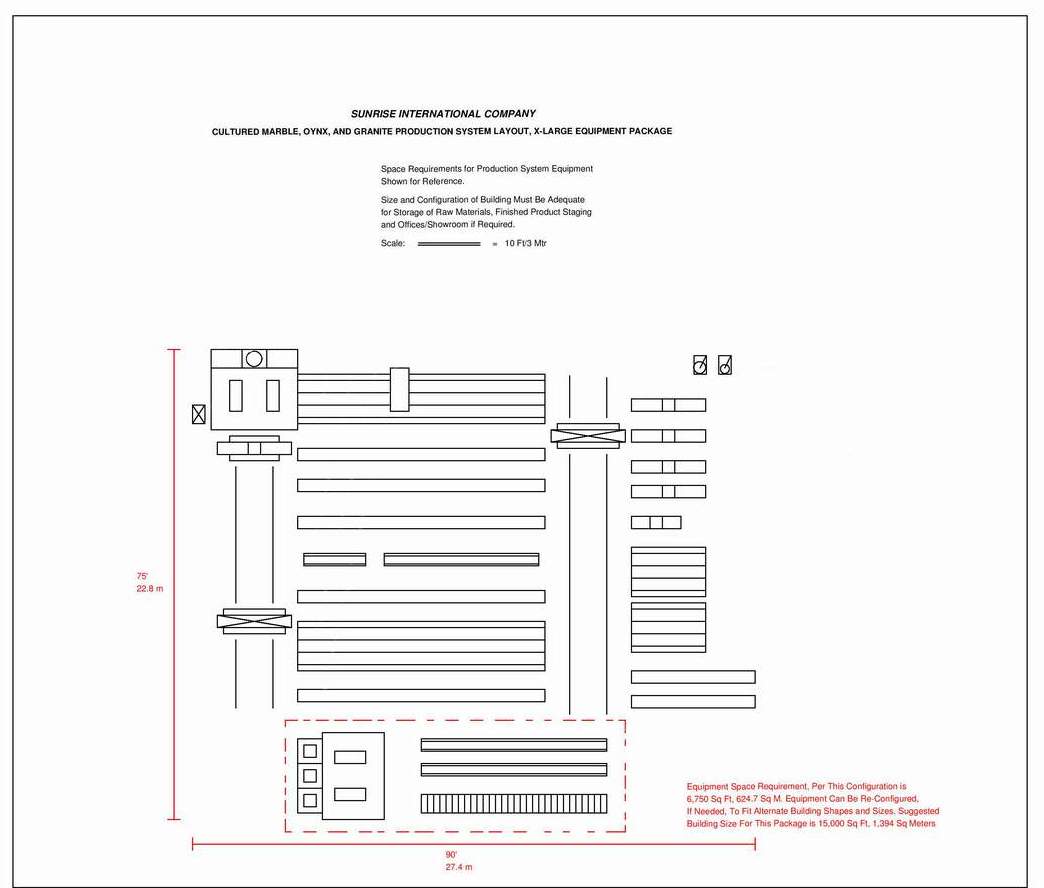
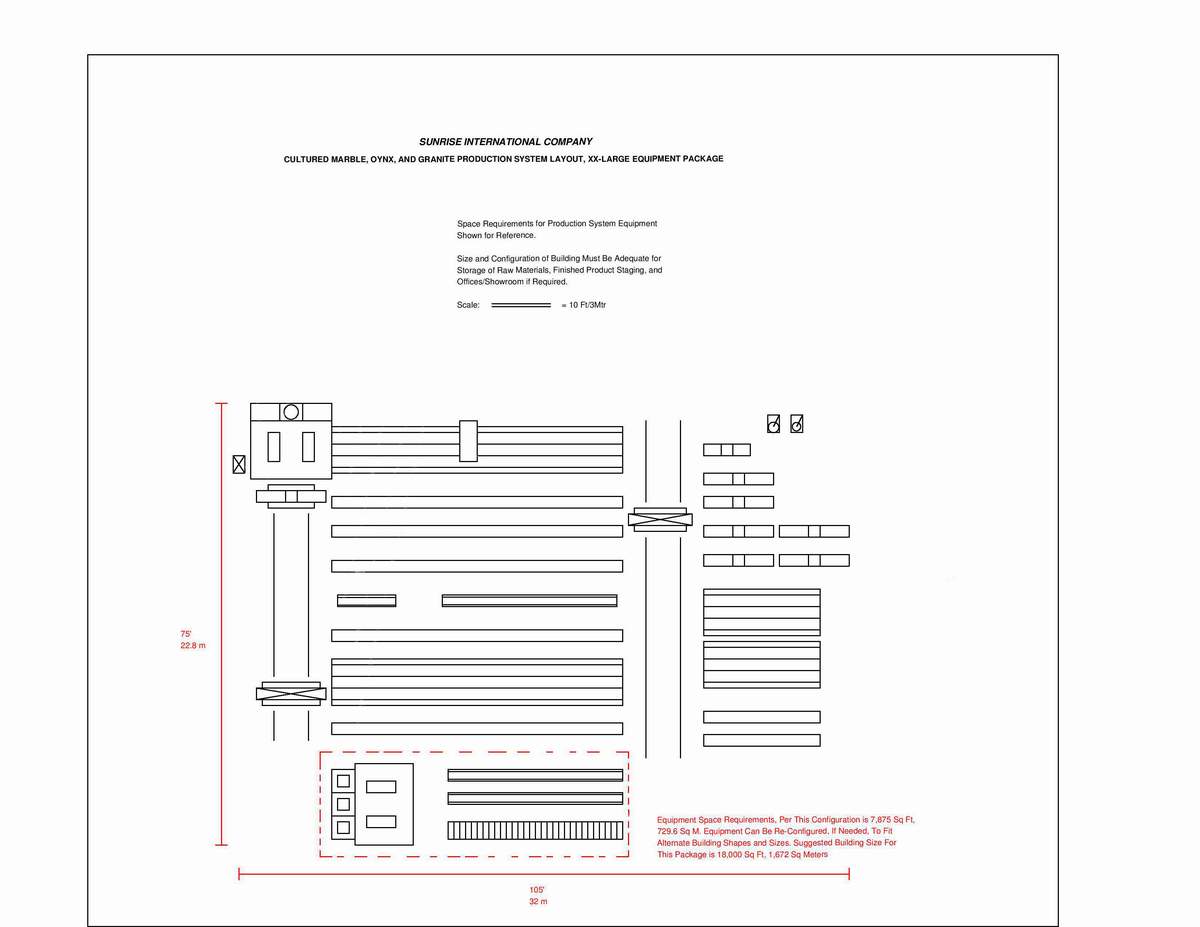
A cultured marble or solid surface factory that isn't laid out with the proper equipment will turn out to be like a bumper car ring at an amusement park. Your employees will have ten different paths guaranteeing their running in to each other, creating chaos and waste time in your factory. A factory laid out with the proper equipment will assure a smooth operating factory, decrease your labor cost, increase your production, will require less than half the manufacturing space, therefore increasing your profits exponentially. This increase in profits will pay for the equipment in a short period of time. Plus, we can offer you molds, equipment, and supplies for less than others charge you for molds only. You can click on any photo on this page to see a larger view, and you can also see more operating equipment on the "Photos" page. On this page I also show a typical cultured marble factory layout with equipment such as blender, vibrating table, transfer cart, multi level storage racks, conveyor lines, gel coat spray booth, etc., and give a description, in sequential order, how each is used. When you contact me, I will send you an equipment list that will fit your budget. |
Cultured Marble Manufacturing Equipment Layout |
|
You can view the factory layout above while I explain the manufacturing process and give a brief description of the cultured marble manufacturing equipment involved to build an efficient manufacturing system. The equipment includes roller track / conveyor lines is designed to save space and move your molds through the proper sequence to maximize production. I have numbered the manufacturing steps 1 through 8 in the drawing as well as in the description. Every factory building and every individuals requirements are different, so use this only as a general guideline and keep in mind that your factory will be laid out and tailored to fit your needs and requirements.
1. Set up lines: As you can see, this factory layout has two Set Up Lines. In between the set up lines is a shelf and workbench (see “set up line” photo above) that gives you some work space for preparing and setting up the molds, and will hold miscellaneous molds, tools and waxes and other set-up supplies.
2. After the molds are set up and waxed, you will transfer the mold to the Tilt Spray Cart and into the Spray Booth where the gel coat will be applied with the Gel Coat Spray System. You can see a photo of the Spray Booth, Tilt Spray Cart, and Gel Coat Spray System above.
There are two types of gelcoat spray carts. Shown is the Tilt/Rotate Gel Coat Spray Cart. This cart allows the mold to be tilted upwards, making it easier to maintain a uniform gel coat application. It is also capable of rotating 360 degrees so you can rotate the mold to spray the back side of the mold. There is also a gel coat spray cart available without the tilt and rotate option.
Notice the solvent wash tank in the gelcoat area too. You will need to clean your gel coat spray gun to keep it spraying efficiently. You can also see the roller track or v-guide rails in the Tilt Spray Cart photo above. The Spray Cart travels on the rails that are attached to the floor.
3. After the mold has been gel coated, the gel coat will need to cure for a time prior to pouring it. I know ‘for a time’ sounds very vague, but your gel coat curing time will vary depending on the brand of gel coat, the type of catalyst (hardener) the temperature. Keep in mind that with all polyester resins, the colder the weather, the slower the cure and the warmer the temperature, the faster they will cure. So, if I am in Moscow in the winter, my gel time will be much slower than if I was in Funafuti, Tuvalu.
In cold climates, I highly recommend a gel coat heat tunnel in this area. This can cut your gel coat curing time in half. Time is money. It’s not uncommon to have a gel coat cure time of 45 minutes to an hour in a cold climate if you’re not using any heat. It is not cost efficient to heat your whole factory for a faster gelcoat curing time but it makes dollars and sense to warm your mold. The sooner your gel coat is cured, the sooner you can pour your marble on it. A small amount of heat applied to the gel coated mold can make a huge difference in your gel coat cure time and therefore how many pounds-per-day you produce. The heat tunnel can be beneficial even if you don’t require heat. It keeps the freshly gel coated mold protected from any contaminates until it is cured. You will only need a fan to circulate some air when heat is not required.
4. Once your gel coat is cured, it will be moved to the vibrating table using the Transfer Cart (See Photo) to be poured on. The cultured marble, onyx, or granite matrix is mixed in the blender (mixer) and poured on the mold while the vibrator on the vibrating table is turned on. (There are three sizes of blenders available; 150 pound, 250 pound, and the large 350 pound.) The vibrating table levels the cultured marble matrix, onyx, or granite matrix, and allows the air inside the matrix to rise to the surface. The Pot Washing Tank you see in the mixing area (and in a photo above) is to clean the cultured marble blender bucket, or pot, at the end of each shift, or in between mixing different colors. You can see the vibrating tables and the blenders in photos above. You may also notice the Mixing Area Ventilation System. It may not be a requirement, but it is an excellent system to reduce the dust in your factory.
5. Once the mold is filled, you will move the full mold to the Mold Storage Rack. This drawing shows a single level mold storage rack, but a multi level storage rack can be up to four levels high which obviously stores four times more molds in the same amount of space. The Mold Storage Racks can be extended in both length and height as your factory expands and as you add more molds to your inventory. You will always be expanding your market by including additional sizes and styles of molds, and you will also require additional mold storage space to accommodate them. If a single level storage rack is used a simple transfer cart may be used, but if you have multi-level storage racks or expect to add additional levels to your storage racks, you may want to consider the Transfer Lift / Scissor Lift in the beginning. You can see the Transfer Lift / Scissor Lift in a photo above.
6. When your cultured marble parts are sufficiently cured, you will roll them to the demold storage area, which is a working area to remove your finished parts from the mold and to prepare the molds for the setup line.
7. Every cultured marble, onyx, or granite part you produce will have flashing around the edge of the part that will need to be sanded off. If the cultured marble mold is poured the proper thickness, sanding will be kept to a minimum. In training, you’ll be taught how to keep your sanding to a very minimum. The more proficient the employee in the matrix pouring area, the less time will be required for sanding. The Dust Collector shown in the diagram will keep the dust out of your factory, and you can see the photo of the Dust Collector (or Grinding Booth) above.
8. Buffing line. I have heard some people say that ‘no buffing is required’ on cultured marble or similar products. Not in a million years! There is not a marble shop in the world that doesn’t require at least some buffing, but the goal is to keep the buffing to a minimum and with a little discipline, this can be achieved. Your marble will be an exact replica of your mold, so it makes sense to spend a little time maintaining your molds and buffing off any small imperfections. Any imperfection on your mold will show an imperfection on your marble, so you will obviously want to buff off that imperfection. Even if your mold was perfect, you will still want to buff off the mold release wax that was used on the mold and give your finished product a little extra shine and rich appearance. Two helpful hints: 1.) Put excellent lighting in this buffing / detailing area. 2.) Incorporate a mold maintenance policy in your factory and stick to it.
Solid surface manufacturing equipment is also available so if you intend to manufacture solid surface and want additional information, let me know. Solid surface equipment can be incorporated into your cultured marble factory, or we can design a factory exclusively for producing solid surface products. Solid surface equipment includes a vacuum blender, stainless steel solid surface molds, wide belt sanders, overhead gantry, and post curing oven. I am working on a page for solid surface manufacturing, and I will have it up as soon as possible.
You can see some various size Factory Layouts on the bottom of the "Factories" page. |
![]() |
![]() |